Rotational Molding Process: How Plastic Tanks Are Made
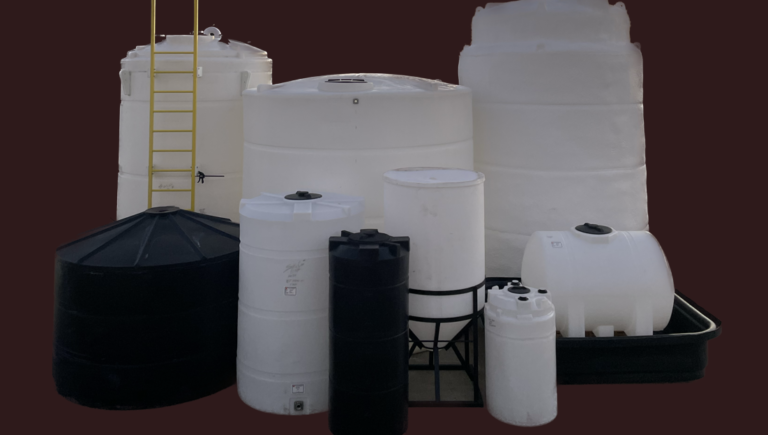
The rotational molding process makes a plastic tank by loading powdered resin into a hollow metal mold, then heating that mold in a large oven while it slowly rotates on two axes at once. The melting resin coats the entire inside of the mold, builds up a seamless one-piece wall, and is then cooled and pulled from the mold as a finished tank shell — no seams, no welds in the primary shell, no glued joints. At Bailiff Enterprises, Inc. in Willis, Texas, we have been rotationally molding and fabricating plastic storage tanks since 1981, and we ship HDPE, polypropylene and PVDF (Kynar) tanks nationwide.
What Is Rotational Molding?
Rotational molding — often shortened to rotomolding — is a low-pressure molding method for hollow plastic parts. Unlike injection molding, which forces melted plastic into a mold under high pressure, rotomolding relies on heat and gravity. Because the resin is never forced or stretched, the finished part is low-stress, and the one-piece construction is why Bailiff rotomolds its water and chemical storage tanks: there is no seam for a chemical to attack and no joint to fail.
If you are comparing suppliers, it helps to know that many tank sellers are distributors. Bailiff is the factory — the molds, the ovens and the fabrication shop are all under our roof in Willis, Texas. You can read more about our molding operation in our overview of rotational molding tanks.
The Rotational Molding Process, Step by Step
- Weigh and load the resin. A measured charge of powdered resin is loaded into the hollow mold. The weight of that charge is what sets the wall thickness of the finished tank — more resin, thicker wall.
- Close and clamp the mold. The two halves of the mold are bolted together so the part molds as one seamless piece.
- Heat and rotate. The mold goes into the oven and rotates on two axes at the same time. As the mold heats, the powder melts and fuses layer by layer onto every interior surface — walls, dome and floor in one continuous shell.
- Cool while still rotating. The mold moves out of the oven and keeps rotating while it cools, so the wall sets evenly instead of sagging or thinning.
- Demold. The mold is opened and the finished tank shell is pulled. This is the moment a pile of powder becomes a tank.
- Trim, fit and test. Fittings are installed, fabricated items like double-wall containment are welded up in the shop, and every tank is water-tested before it ships.
Materials We Rotationally Mold
We mold and fabricate three thermoplastics, each matched to the chemical it will hold. Always check your chemical against our free chemical compatibility chart before selecting a material.
| Material | Resin We Use | Capacities | Typical Use |
|---|---|---|---|
| HDPE (high-density polyethylene) | Dow RESILITY DPDB-3220 NT 7 | 550 – 10,000 gallons (standard verticals; containment sizes also available) | Water, many common chemicals; 50% caustic soda tanks are HDPE molded at 2.2 specific gravity |
| Polypropylene | PSD Rotoworx RMPP141 Natural | 10 – 8,000 gallons | Higher-temperature service and chemicals that attack HDPE |
| PVDF (Kynar) | Arkema KYNAR FLEX 2850 WR | 10 – 4,000 gallons | Aggressive and high-purity chemical service |
Our standard tanks are rated for liquids up to 1.9 specific gravity, with 1.5 and 2.2 ratings available. Specific gravity is simply how heavy the liquid is compared to water — a heavier chemical pushes harder on the tank wall, so it needs a heavier wall.
What Happens After the Mold
Molding is only half the job. In the fabrication shop, a handful of DVS-certified welders build our 1,550 and 2,500 gallon double-wall tanks in house in polypropylene or PVDF, and install fittings on molded tanks. For oxidizers like sodium hypochlorite and for high-concentration sulfuric acid, we use mechanical sidewall fittings rather than welding on the wetted sidewall — a detail that matters for tank life.
Every tank is water-tested before it ships. Upright HDPE tanks are manufactured to ASTM D1998 where it applies. All of our tanks are atmospheric tanks — they are not pressure vessels — and flanged connections are ANSI 150. We also recommend flexible connectors on every tank, because rigid hard-piping is one of the main causes of cracked fittings and sidewalls.
Frequently Asked Questions
Is rotational molding the same as rotomolding?
Yes. Rotational molding, rotomolding and roto-molding all describe the same process: melting powdered resin inside a slowly rotating heated mold to form a seamless hollow part.
How is rotational molding different from injection molding?
Injection molding forces melted plastic into a mold under high pressure and suits small, solid parts made in huge volumes. Rotational molding uses low pressure and biaxial rotation to build hollow parts — like tanks — with seamless walls and much lower tooling cost for large parts.
Are rotationally molded tanks pressure rated?
No. Rotomolded tanks are atmospheric storage tanks, designed for liquid at normal atmospheric pressure. They are not pressure vessels and should never be pressurized.
What determines the wall thickness of a rotomolded tank?
The resin charge loaded into the mold and the tank’s specific gravity rating. A 2.2 SG tank carries a heavier wall than a 1.5 SG tank from the same mold because more resin is loaded for the same part.
Are Bailiff tanks NSF certified for drinking water?
Our HDPE resin is NSF-approved, but our finished tanks are not yet NSF/ANSI/CAN 61 certified. If you need a tank for potable water service, tell us when you request a quote so we can discuss your application honestly.
Get a Tank From the Factory That Molds It
Since 1981, Bailiff Enterprises has molded and fabricated plastic storage tanks in Willis, Texas and shipped them nationwide. Tell us your chemical, concentration, temperature and capacity, and we will match the material and specific gravity rating to the job — starting with the chemical compatibility chart.